A small food producer has one chance to make a good first impression: a few seconds after landing on the website, the customer sees whether the brand is credible and whether they want to try the product. For Sokoniada, a brand of natural cold-pressed juices, we prepared a lightweight website that shows the juices, tells the brand’s story and leads to contact: sokoniada.pl. In this case study we describe how we approached the website of a cold-pressed juice producer and what exactly works on it.
In short: a website for a cold-pressed juice producer
- Client: Sokoniada, a producer of natural cold-pressed juices
- Industry: food production and sales, fruit and vegetable juices
- Scope: website design, layout in Blocs, product pages, a contact form, a cookie banner, a sitemap
- Technologies: HTML, CSS, Bootstrap, JavaScript, Blocs, lazysizes, WebP images
- Website: sokoniada.pl
The challenge: make the juices look appetising and the brand credible
According to the website, Sokoniada presses juices from fresh fruit and vegetables, including apples, rhubarb, Japanese quince, beetroot and blackcurrant, with no artificial additives. An overloaded website does not suit such products. What is needed is a clean form, good photos and an understandable explanation of what cold-pressed juice is.
The producer needed a website that:
- shows the juice range in a few seconds,
- tells the brand’s story in plain language, in sections that can be read on a phone,
- contains factual product information: ingredients, volume, storage,
- is fast and cheap to maintain, because it has no shop or elaborate panel,
- gives a clear path to contact by phone, email and form.
How we worked on the project
- Defining the role of the website: an informational business card for the brand, with no online sales.
- Visual design: light green shades associated with fruit and the garden, plenty of light and large photos.
- Implementation: a website built in Blocs, with image optimisation and lazy loading.
- Testing: checking the phone view, the form and the product pages.
In such projects the biggest risk is excess. The producer wants to say everything about themselves, while the customer is looking for three pieces of information: what these juices are, what they are made of and how to get in touch. That is why at the conversation stage we agreed the hierarchy of content and set aside whatever could distract, such as elaborate galleries or long company histories. Any additional section can be added later, when the need arises.
The solution: a lightweight website instead of a heavy shop
We decided on a static website built in Blocs on Bootstrap. There is no database or CMS panel to keep updated, so the site loads quickly, is simple to host and has fewer elements vulnerable to attack than an extensive system. For a producer who changes the offer a few times a year, it is a sensible compromise between cost and quality.
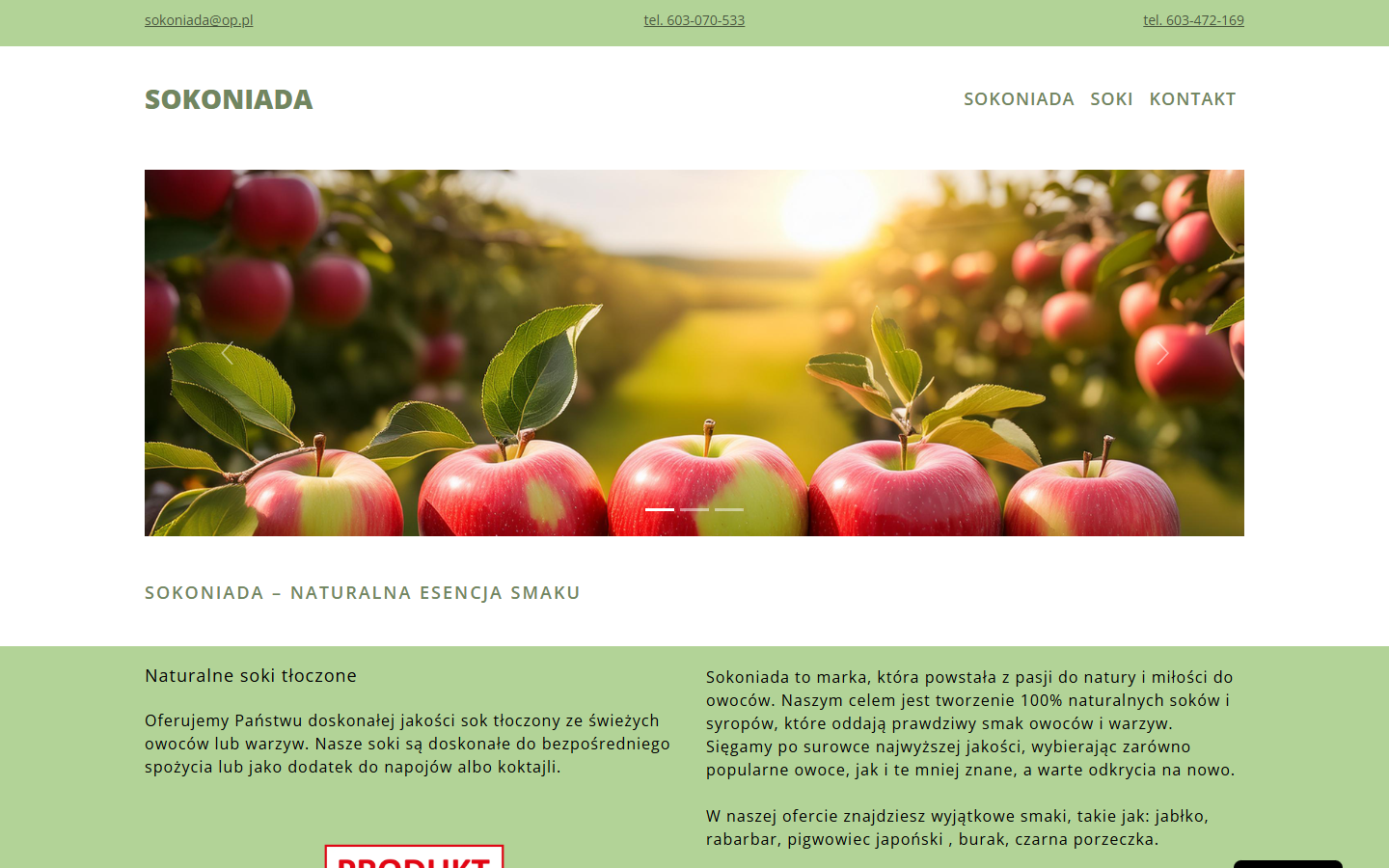
We designed the website around a few simple principles. First, photos take priority over text, because juices are bought with the eyes. Second, the palette is based on light green and white, with a darker green in headings and buttons, so the text stays readable. Third, every page has the same bar with an email address and phone numbers, so the customer never has to look for contact details. On top of that comes the Open Sans font, neutral and well known from reading on screens.
Carousel, brand story and appetising photos
The first screen is a carousel with three large photos of fruit, and beneath it the heading “Natural essence of flavour” and a description of the brand. The images are prepared in WebP format and loaded lazily, so they do not slow down the entry to the website. Further down the home page you can see the “Produkt Polski” (Polish Product) mark and photos of bottles and fruit.
Juice list and product pages
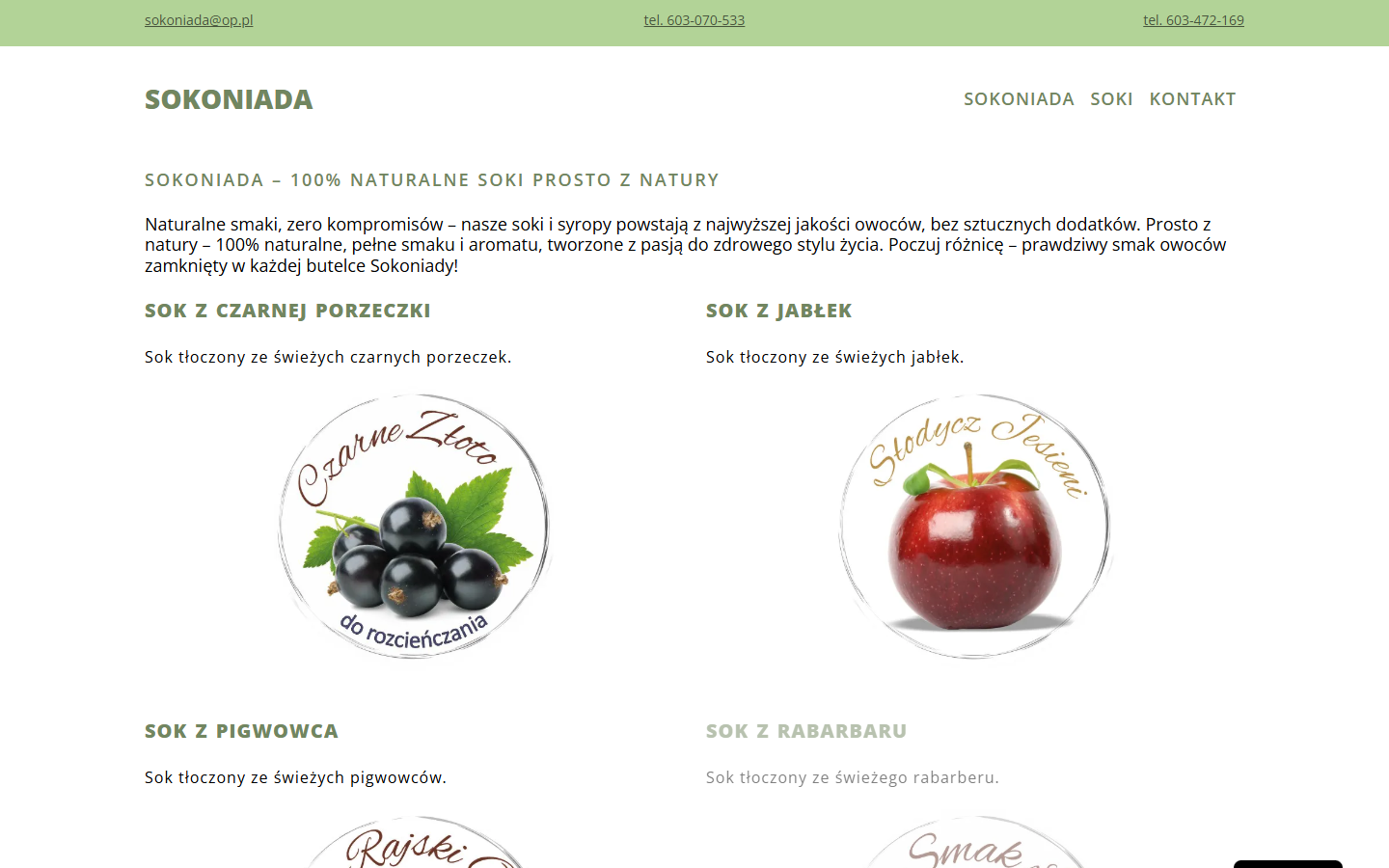
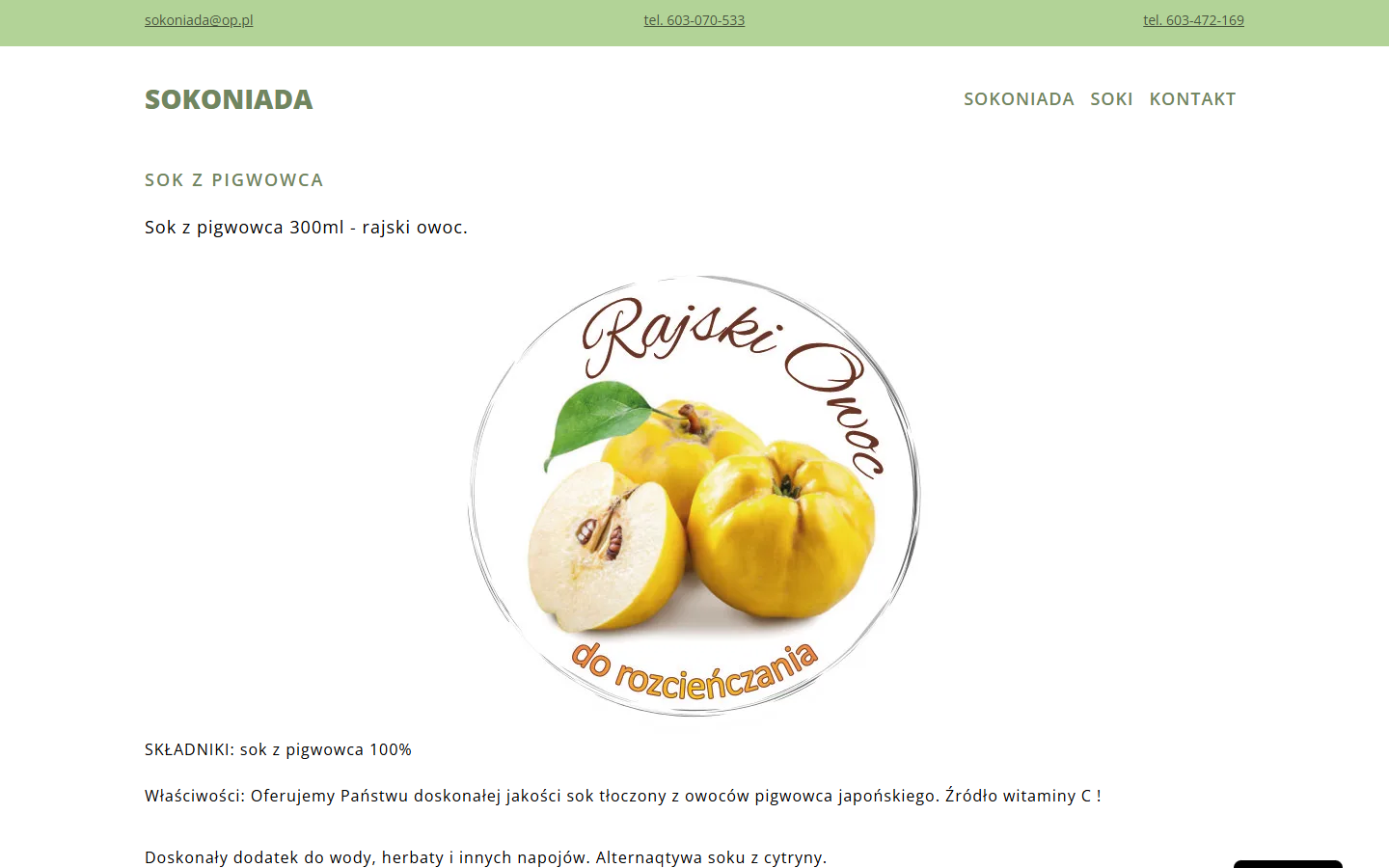
The Juices tab shows all the juices in a two-column layout: blackcurrant, apple, Japanese quince, rhubarb and beetroot juice. Each has a label with an illustration and a short description. Separate product pages, for example Japanese quince juice or beetroot juice, give the volume of 300 ml, the ingredients (100% juice from the given fruit), information about pasteurisation and storage tips: keep in the fridge after opening and consume within 7 days, and treat sediment as a natural phenomenon.
Sections that tell the brand’s story
The pages also have several short sections that build the brand: “Close to you”, “Quality first”, “From cultivation to finished product” and “Pure taste, zero compromise”. These are the producer’s claims, according to which the juices are made without artificial additives, preservatives and colourings. The text about the properties of the fruit also comes from the client. Our role was to give it a clear form: short paragraphs, headings and plenty of white space, so the reader does not get lost in dense text.
This division also has a practical dimension. The juice list serves as a catalogue in which the customer compares flavours, while the product pages let us provide details we do not want to cram into the list. If the producer adds a new flavour, another page of the same structure is simply created, so expanding the offer does not require rebuilding the whole website.
Contact and form
The header of every page contains an email address and two phone numbers, and the Contact page has the company’s details and a form with fields for name, email address and message. This way the customer quickly finds a way to ask about the juices.
SEO, GDPR and security
- Sitemap: the sitemap.xml file lists the home page, the juice list, contact, terms, the privacy policy and five product pages, as well as images.
- Separate product addresses: each juice has its own address, for example /sok-z-jablek/, which helps search engines recognise the topic.
- Performance: lazy loading of images (lazysizes) and WebP graphics.
- Cookies and privacy: a cookie notice and pages with the website terms and the privacy policy.
- Security: a website without a database and CMS panel has fewer elements that need updating and securing.
To be honest, it is still a simple website. It has no blog or shop, and further SEO work, such as meta descriptions or content about the pressing process, is a natural next step if the producer wants to increase visibility on Google.
In practice, further development could go in several directions. You could add short meta descriptions and structured data for products, a gallery of the pressing process, a section with points of sale, or move to a CMS if the producer wants to run a blog with recipes. Each of these steps can be introduced on the existing website, because its structure is simple and well organised.
Technologies used in the project
- Blocs for building the layout and exporting the pages,
- Bootstrap, HTML5, CSS and JavaScript for responsiveness,
- lazysizes and WebP images for speed,
- cookieconsent for the cookie notice,
- sitemap.xml for search engines.
The result: a coherent brand business card and simple contact
Sokoniada has a website that shows the juices, tells the brand’s story and makes contact easy, without the costs of maintaining a shop or panel. We have no traffic or sales data, so we give no numbers. The value is that the producer can present themselves to customers in a professional way and add another flavour at any time as a new page. The website is fast, readable on a phone and consistent with what the brand communicates: simplicity, naturalness and the taste of fruit, not embellishment. This means further changes, from a new photo to an extra flavour, are made quickly and without risk to the rest of the site.
From the agency’s perspective it is a good example of matching the tool to the need. Had we proposed an online shop, the producer would have paid for features they do not use and would have had to handle orders they do not want to fulfil. Instead they got a website that does what is expected of it: builds trust, shows the products and leads to a conversation.
Who this solution is for
Such a website works well for small food producers, farms, makers of local preserves, bakeries, vineyards and apiaries, and anywhere a credible brand appearance matters and sales happen offline. If you need booking or a shop, see our projects: a boat booking system, described in a separate case study.
Frequently asked questions about a food producer’s website
Does a small juice producer need an online shop?
Not right away. If the products are sold mainly directly or through retailers, a good business card website with a description of the brand, a juice list and quick contact is enough. It is worth adding a shop when the producer is ready to handle orders, packing and shipping of food. The Sokoniada website was designed as an informational one, which its own terms confirm.
How does a static website differ from WordPress?
A static website is ready-made HTML, CSS and JavaScript files with no database, so it runs fast and is simple to maintain. WordPress gives you a convenient panel for editing content, a blog or a shop. With a few pages and infrequent changes, a simpler static website is often enough; with frequent updates, a CMS is better.
What should a food product page contain?
The name and volume, ingredients, information about pasteurisation, storage and consumption-after-opening tips, and the producer’s contact details. That is how the Sokoniada juice pages are built. Information obligations towards consumers depend on the way of selling, so it is always worth confirming them with a food law adviser.
Can health properties be described on a food producer’s website?
With great caution. Health claims about food are regulated by EU Regulation No 1924/2006, and not every statement is permitted. As the website contractor we are responsible for its form, and any health content supplied by the producer should be checked by someone who knows the rules.
How do you make a producer’s website visible on Google?
The basics are separate product pages, clear headings, image descriptions, a sitemap and fast loading. For a local producer, consistent contact details and descriptions of the pressing or the origin of the fruit also matter. Results in search, however, take time and regular content, so a specific position cannot be promised.
A simple food producer website: when a static business card is enough
Sokoniada sells juices offline, so it needs neither a shop nor a CMS panel. We chose a static website with a separate address for each juice, a sitemap and lazily loaded WebP images. It is a good example of the principle that the tool should fit the need: fewer elements to update means lower cost and a smaller attack surface. If the producer wants to develop content, for example a blog with recipes, the website can move to a CMS, and expanding with a new flavour is just another page of the same structure. To be honest, it is still a simple website, and the next step could be meta descriptions and structured data for products.
Loading speed is one of the factors in how a website is perceived and is worth measuring; the principles are described in the article on optimising WordPress website speed. You will find the principles of a clear layout and content hierarchy in the text on website design. A similar path, but with technical data and a B2B form, is shown by the website of the organiser manufacturer ECODDC.
If you are not sure whether you need a business card site or a shop, compare the costs in the calculator or book a free conversation.
Need a website for your brand?
We build business card websites, shops and booking systems for companies and producers. See our services, check other projects or get in touch with us right away. The first conversation is free.


