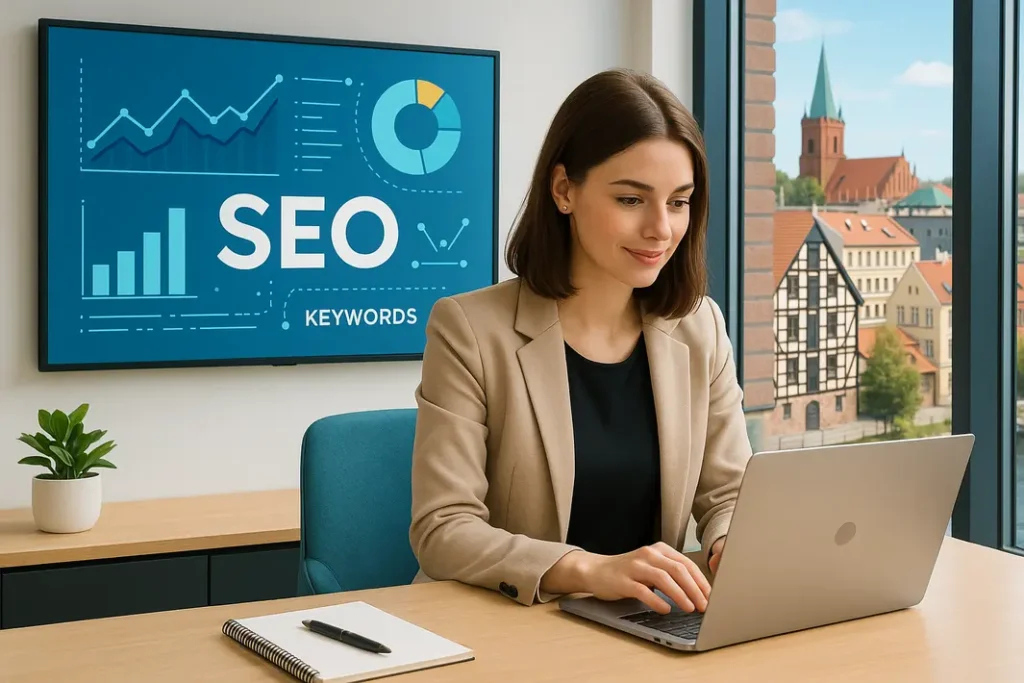
When someone types “hairdresser Bydgoszcz”, “mechanic near me” or “law firm Fordon” into their phone, Google usually shows a map with a few businesses first, and ordinary results only below it. Local SEO in Bydgoszcz is a set of actions that help your business appear in that block and in organic results for queries with a location. It applies to clinics, workshops, restaurants, law firms and brick-and-mortar shops.
In this guide we go through the practical order of work: from Google Business Profile, through consistent contact details and site structure, to structured data in WordPress, reviews and measurement. We do not promise specific rankings, because they depend on competition in your industry and neighbourhood, and local SEO is a process counted in months.
General topics such as technical audits or link building are covered in the text on data-driven SEO for websites in Bydgoszcz.
How Google assesses local businesses
Local results in Maps and in search rest on three groups of factors that Google describes in its help: relevance, distance and prominence. Relevance says how well the Business Profile matches the query. Distance is the business’s location relative to the searcher or to the place named in the query. Prominence comes from how well known the business is online: from reviews, links, mentions and content.
You cannot influence distance: a business from Fordon will not outrank one from Śródmieście in “near me” for a person standing by the Old Market Square. The other two factors you influence strongly.
Google Business Profile: the foundation
Google Business Profile in Bydgoszcz (formerly Google My Business) is the single most important element of local SEO. You will find the official guidance in the Business Profile help centre.
Setting up and verification
Type your company name into Maps and check whether the profile already exists, because Google often creates it automatically, or a former employee does. If so, claim the right to manage it instead of creating a duplicate.
Verification is done by the method Google offers for your business, most often a code by phone, email, video or post. If you receive customers at an address, enter it exactly. If you travel to customers (a plumber, a cleaning crew), you can hide the address and indicate a service area.
Name, categories and services
- The name is exactly the one you actually operate under, without tacking on keywords like “Plumber Bydgoszcz cheap”. Google’s guidelines forbid this.
- The primary category has the biggest influence on which queries you appear for. Choose the most precise one, not a general one, and pick additional ones to match the services you really provide.
- Services and products describe in your customers’ own words, with a short description. This is the place for phrases like “oil change”, “vehicle inspection”, “dietary consultation”.
- Opening hours update for every holiday and vacation.
Photos, posts and description
Add real photos: the entrance, interior, team, projects. Posts (news, offers, events) show that the business is alive. Write the business description naturally: what you do, for whom and in which area.
NAP consistency across the web and local directories
NAP stands for Name, Address, Phone. Google compares them in many places, and the more consistent they are, the more certain it is that this is one and the same business. Differences in spelling (“ul. Gimnazjalna 2” versus “Gimnazjalna 2/M501”, an old phone number, a different name in the company register and in Maps) introduce unnecessary noise.
Make a simple spreadsheet: company name, address, phone, email, website address, hours. Then review: your company website (footer and contact subpage), Business Profile, social media profiles, listings in industry and local directories, and Bing Places. Copy the data from a single master. Entries in proven industry and regional directories are useful, but mass submission to random databases makes no sense.
Service pages and local pages without duplicating content
A well-built company website has a separate subpage for each main service. Instead of one “Offer” page, it is better to have separate subpages, e.g. “SEO services” or “WooCommerce shops”. Each answers one customer question and has its own title, heading and description.
“Service + district” pages
It is tempting to copy one page and swap the district name (“service Fordon”, “service Okole”). Google calls these doorway pages and treats them as spam if they differ only in the place name.
A local page makes sense only when it contains something unique to that place:
- a real address or reception point in that location, or a specific description of how to get there and where to park,
- projects and reviews from that area,
- travel time, service rules, any additional costs.
If you do not have these, one “Service area” page with a list of districts and cities (Bydgoszcz, Toruń, Inowrocław, Nakło, Solec Kujawski) and a description of service in each is better.
LocalBusiness structured data in WordPress
Structured data in JSON-LD format helps the search engine read unambiguously who you are and where you operate. For a local business, the LocalBusiness type or its more specific subtypes (e.g. restaurant, clinic) is used, and for businesses without customers on the premises, Organization. They do not guarantee standing out in the results, but they make the page easier to interpret. The rules are described in Google’s search documentation.
The basic set of fields is: name, address (street, postcode, town), phone, email, website address, opening hours, logo and social profiles. The data must match what is visible on the site and in the Business Profile.
In WordPress you have three typical ways to implement it:
- An SEO plugin (e.g. Yoast or Rank Math) with organisation and local data settings. The fastest option for simple needs.
- Your own JSON-LD snippet inserted in the theme header or via a custom plugin. It gives full control, but requires care to keep it up to date.
- A custom solution, where company data is taken from one place in the panel and the schema is generated automatically on the home page, contact page and service subpages. We prepare such solutions as part of our services.
After implementation, check correctness in Google’s rich results testing tool and in Search Console reports. Do not combine a plugin with manually pasted code, because conflicting entries appear.
The contact page and map
The contact page is more important for local SEO than is usually assumed. It should contain the full NAP written as text (not only as an image), working hours, directions and parking tips, and an embedded map.
Beware of heavy embeds: a map loaded straight away can slow the page down. Load it lazily (after scrolling) or only after a click. We write about how speed affects the perception of a site in the guide to WordPress site speed optimisation.
Local content that makes sense
Being local in content does not mean inserting the word “Bydgoszcz” in every third sentence, but answering the questions of customers in your city:
- Case studies: short descriptions of projects with context, that is, who the client was (if they agree), what problem they had, what was done and what the result was. Our case studies are an example of this approach, e.g. the website of a brow and lash salon in Bydgoszcz or the dietitian’s website with online booking.
- Guides: “how to prepare for a visit”, “what to bring to an inspection”. They catch long-tail queries and build trust.
Easy slot selection shortens the path from search to appointment, which we write about in the text on online booking systems for Bydgoszcz businesses.
Reviews: how to get them honestly
Reviews affect both visibility and the decision of a customer comparing three businesses from the map. The rules are clear:
- Ask, but do not buy. Send a request after a completed service, e.g. by text message or email with a direct link to leave a review. Never offer a discount or gift for a positive rating.
- Do not filter. Directing only satisfied customers to Google (a “review gate”) goes against Google’s rules.
- Do not fake. Reviews from people who were not customers are removed, and the profile may be restricted.
- Respond to every one. To positive ones briefly and specifically, to negative ones calmly, factually, without revealing customer data, with an offer to talk outside the review. A future customer reads the responses, not just the stars.
Local links and mentions
In local SEO, a link from a place that is genuinely tied to your area can be valuable: industry associations and chambers you belong to, partner companies, organisers of events you support, local portals and media, and schools or universities you work with. A few such links are usually worth more than hundreds from random directories.
A good control question: would this link make sense if Google did not exist?
Measuring results
A few sources are enough:
| Source | What it shows |
|---|---|
| Google Business Profile (statistics) | Profile views, clicks to the website, calls, direction requests, search phrases |
| Google Search Console | Queries, pages, clicks, impressions and average position in organic results, including for phrases with a location |
| Manual check | Local results for a few key phrases, from a phone, in incognito mode, from different places in the city |
Watch trends over months, not days. In local results large fluctuations are normal. The most valuable is data on calls and directions, because it shows a real wish to make contact, not just visibility.
Local SEO checklist for a Bydgoszcz business
- Check whether your business already has a profile in Maps, and claim it instead of creating a new one.
- Verify the profile using the method indicated by Google.
- Set a name matching the real one, without SEO additions.
- Choose a precise primary category and additional categories.
- Fill in services or products together with descriptions.
- Complete the opening hours and update them for holidays.
- Add your own photos: entrance, interior, team, projects.
- Publish posts about offers and events.
- Establish a NAP master and make it consistent everywhere.
- Submit the business to a few valuable industry and local directories and to Bing Places.
- Create separate pages for the main services.
- Create local pages only where you have unique content.
- Implement LocalBusiness or Organization structured data in JSON-LD.
- Prepare a contact page with NAP as text, a map, directions and a clickable phone number.
- Publish a few case studies and guides with local context.
- Introduce a steady, honest process for asking for reviews.
- Respond to all reviews, including negative ones.
- Gain links from local partners, associations and media.
- Check the speed and usability of the site on a phone.
- Review Business Profile and Search Console statistics every month.
If you want to check how your site looks in terms of the basics, use the free SEO audit. You will find other tests in the tools tab.
Frequently asked questions
How long does it take for local SEO to start delivering results?
The first changes are usually visible after a few weeks, but stable results appear after a few months. The time depends on competition in the industry. No reliable provider will promise you a specific position.
Do I need a website if I have a Google Business Profile?
A profile can work on its own, but a website gives more: a description of services, case studies, guides, structured data and the ability to measure traffic.
Can I have a Business Profile without a business address?
Yes, if you travel to customers. Then you hide the address and indicate a service area.
Is it worth creating separate subpages for each district?
Only if each has unique and useful content, for example projects, directions or specific service rules. Pages that differ only in the district name are considered doorway pages and can harm the site.
Can I ask customers for reviews in exchange for a discount?
No. Offering a benefit for a review goes against Google’s rules. You can, however, politely ask for a rating after a completed service and make it easier with a direct link.
How can I check whether local activities are working?
Compare over time the Business Profile statistics (calls, directions, clicks to the website), Search Console data for queries with a location, and analytics events such as a phone click or form submission.
Let’s talk about your business’s visibility in Bydgoszcz
If you want to tidy up local SEO, implement structured data in WordPress or build a website that supports your Business Profile, book a free conversation with us. The first conversation takes 30 to 60 minutes and is non-binding, and you receive a fixed-price quote afterwards. You can also look at our case studies or use the pricing calculator. Write via the contact page or use the details below.
Kreatywna Agencja (Canpol Bis Sp. z o.o.)
ul. Gimnazjalna 2, 85-007 Bydgoszcz
tel. +48 502 811 949
e-mail: biuro@kreatywnaagencja.com.pl
kreatywnaagencja.com.pl


